Armenian-Pryguny:
From Kars to Los
Angeles
- Karakala,
Kars oblast, Russia
- My
Trip to Turkey, 1999, by Joyce
Keosababian-Bivin
- Why
Armenians Moved to Karakala, by Joyce
Keosababian-Bivin
- First
Armenian Pentecostal Church, La Habra
Heights, California
Karakala
By
Joyce
Keosababian-Bivin and Andrei Conovaloff, February 2009.
Updated 26 June 2018.
CLICK on Pictures to ENLARGE
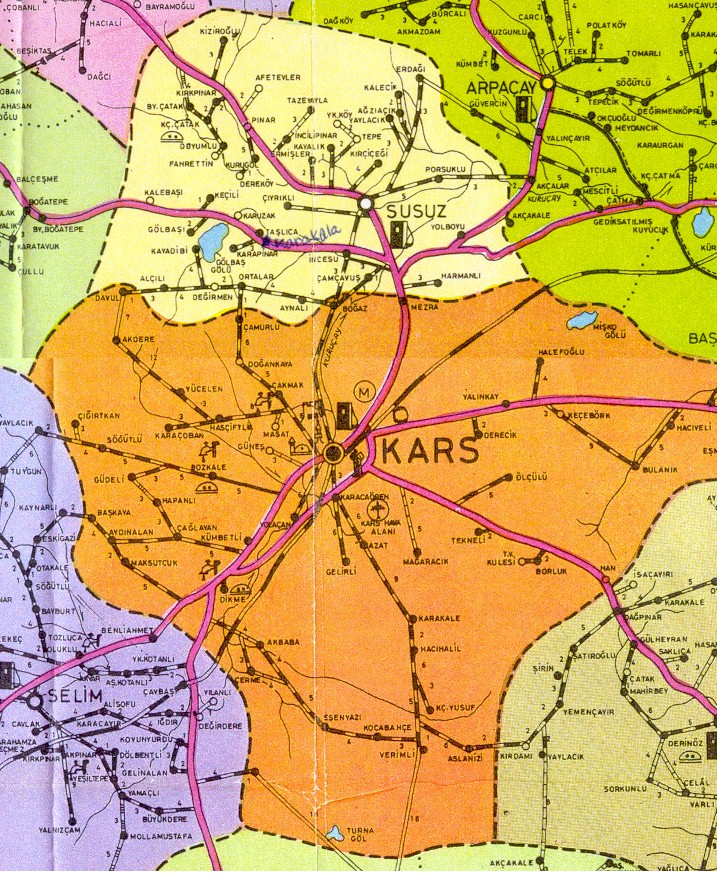
Karakala was a
village where many Armenians who joined the Brotherhood of
Spiritual Christian Pryguny
lived. It was near villages of varieties of Spiritual
Christians resettled from Russia in Kars
oblast (province), Russian Empire. Kars is at the
eastern edge of Turkey.
"Kara kale" means "black
fortress," or just "fortress" or "citadel" in
Turkish, a common location label found in the former
Ottoman Empire. Russian maps show it as "Karakala". It was
an abandoned Russian military outpost. In Eastern Turkey
this place name is a common way for Turks to eulogize
military victories.
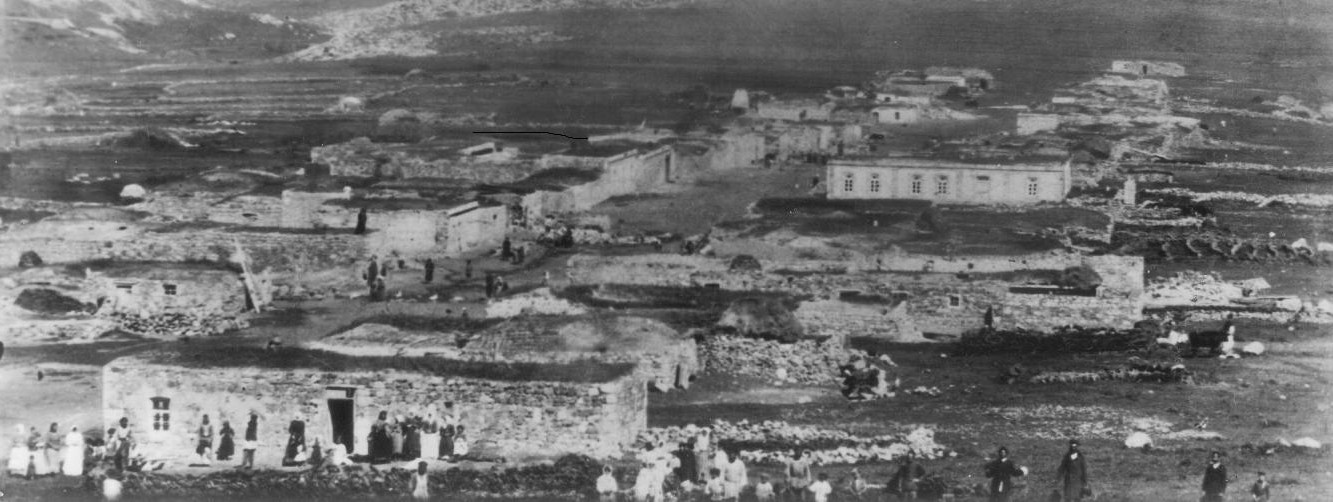
The Karakala village photo (above) was taken in the late
1800s shortly after the Armenians moved in. You can see the residents posing for
the photographer.
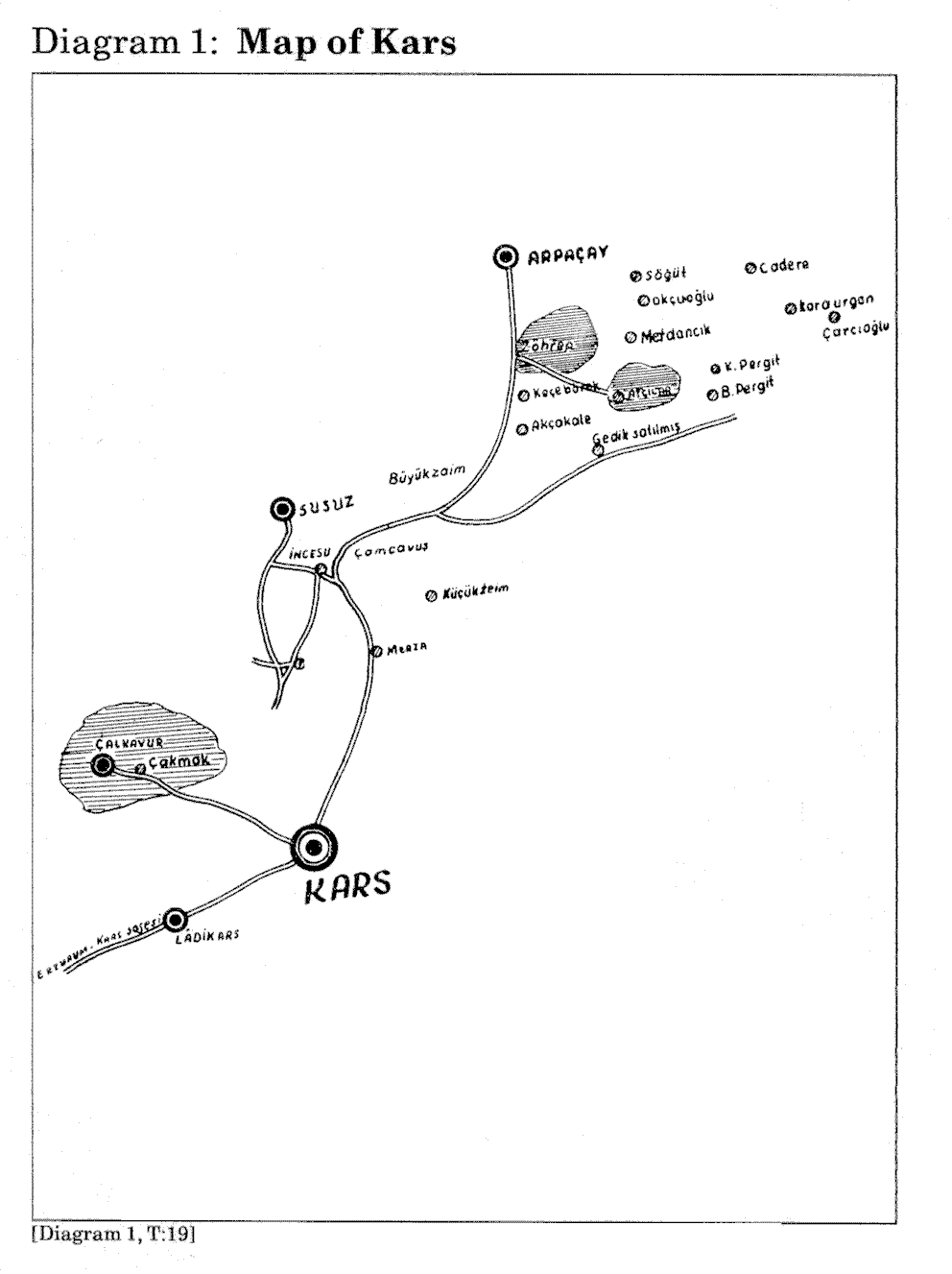
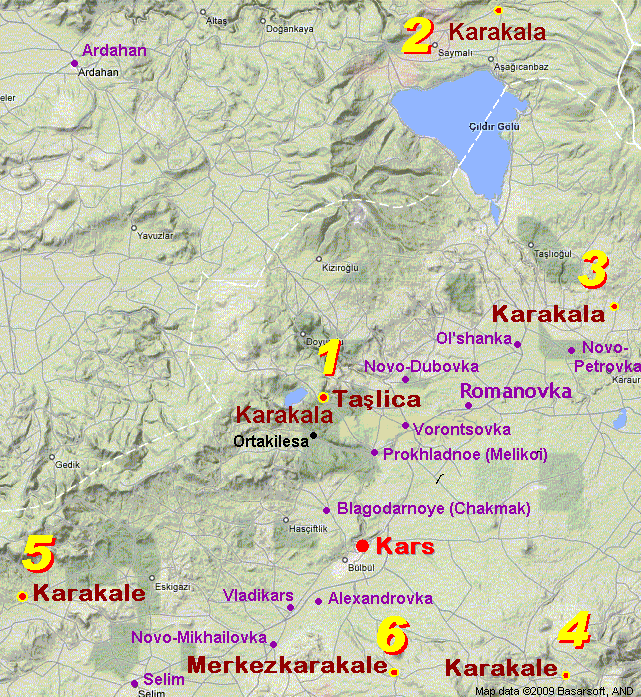
The map below shows locations of nearby villages with
similar names as "Kara kale."
 Folk-protestants from Russia Folk-protestants from Russia
Beginning in the late 1830s, after Russia seized land from
neighboring countries to the south and east, the Tsar
needed to populate the borderlands won in battle with
Russian citizens. Tribes of undesirable non-orthodox state
peasants, and foreign colonies of Germans, in Russia were
offered free land in the Caucasus
by the Tsar. These heretics and foreigners would serve to
populate the newly acquired boundary with Russian
citizens, provide a buffer zone in case of foreign
invasion, and grow food for central Russia.
Most of the heretics were tribes of folk-protestants, many
called themselves Spiritual Christians and many with
leaders had a their own label, like "God's People." But
the Russian Orthodox clergy gave them many overlapping
labels which described their various heresies, variously
translated as — dairy eaters, spirit-wrestlers, Saturday
people, jumpers, flagellaters, etc. Perhaps more than 100
labels were used in various times and places, some groups
getting multiple or changing labels.
Folk-protestants were self-organized tribes and clusters
of clans, each with at least one spiritual leader, not
organized into any hierarchy. Some were large with a
single leader ruling over many villages, like the dukhobortsty
(spiirt-wrestlers). Most were small, sharing a village
with one or more different folk-protestant tribes. Al
these tribes were heretics to the state Church and treated
similarly, as illegals.
The government first resettled many into what is now
Azerbaijan, where about half died, then Georgia and
Armenia, and at the end of the 1800s, Kars
oblast (province, state). Depending on where and
when they were relocated, all were given various amounts
of land, and limited exemptions for taxes and military
duty.
For more about folk-protestants in Russia, see: Klibanov,
Aleksandr I. History
of Religious Sectarianism in Russia, 1860s-1917,
Pergamon Press, 1982.
Russia
took the Kars territory from Turkey in 1887, and gave it
back to Turkey in 1923. Read
more
about the Russo-Turkish wars.
My Ancestral Karakala
In that period my ancestors also moved to Kars Oblast and
were converted to the charismatic religion of the Spriitual
Christian Pryguny (jumpers) — one of many
neighboring tribes of folk-protestants relocated to the
Caucasus. It was unusual for Armenians to join another
faith and they were often scorned by other Armenians as
heretics. We were a hybrid best described in English as
"Armenian-Pryguny" at that time and place. Pryguny
translates as "Jumper."
While collecting my family history since the 1970s, the
elders in Southern California disagreed on the exact
location of Karakala. Some said it was south of Kars,
others said north. The most extensive description I found
is in chapter 1 of the Autobiography
of James T. Agajanian (1965, Payne Publishing
Company, Gardena California):
- Page 1: "Our home was in a village called Ortakilesa
(meaning church in the center of the village), located
about sixteen miles northeast of the city of Kars, two
hundred miles from the Turkish border on the Russian
side of Armenia, and two hundred and seventy five
miles northwest of Mount Ararat. [Ortakilesa is now
named Ortalar, or Ortakoy.]
- Page 3: "Our village was surrounded by seven Turkish
villages, namely, Inaluh, Chamerluh, Berdik,
Kezelchakchak, Geolbashy, Karapoongar and Karakala."
[I have not yet found all of these 7 Turkish
villages.]
- Page 14: "My father ... November, 1911, ...
took me to the village known as Karakala,
approximately thirty five miles away from our village.
This was Armenian Karakala and nearly every member of
the village was Protestant. Not being able to get
along with people of the Gregorian faith, they had
isolated themselves in this village."
From all sources, I find 6 candidates for Karakal(a,e)
villages near Kars, see the map.
Which is our Karakala?
At the time I thought it was #1 on the map above, located
about 11 miles (18 km) north of the city of Kars, at the
location of the present day village of Taşlica (Tushlicu).
Of
the 6 Karakalas shown, this one may be it because:
- It is closer to more of the Molokan and Prygun
villages in Kars guberniya than any other
Karkala candidate.
- It is closest to Romanovka where the Prygun
prophet Klubnikin lived who alarmed many villagers
of upcoming dangers.
- It is the only
Karakala in the area named on a Soviet topographic
map, considered to be the best maps in the world at
the time.
- The lay of the land seems similar to our famous
village photo above, which I discuss below.
 UPDATE 2015: Actually it
was #6. I found an English speaking resident on Facebook
who confirmed his village was the one I was looking for.
Then we sent Vedat
Akçayöz, local Kars historian and descendant of Pryguny,
to confirm this site. He managed to take a photo from
the same position as the historic photo above, and the
terrain matched exactly. Continue reading my earlier
report. UPDATE 2015: Actually it
was #6. I found an English speaking resident on Facebook
who confirmed his village was the one I was looking for.
Then we sent Vedat
Akçayöz, local Kars historian and descendant of Pryguny,
to confirm this site. He managed to take a photo from
the same position as the historic photo above, and the
terrain matched exactly. Continue reading my earlier
report.
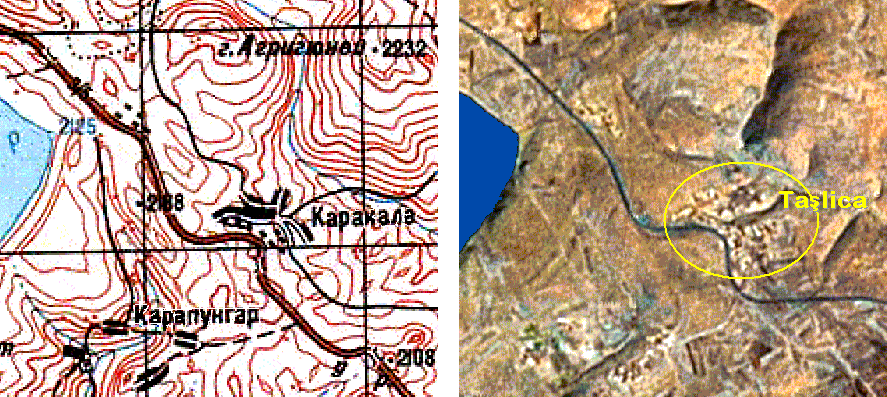
The enlarged Russian topographic map (right) shows the
exact location of Karakala (#1) north of Kars, where the
current Turkish village of Taşlica (Tashlika) is today,
show on a satellite image. In the next section, "My Trip to Turkey, 1999", I further
explain why I think this could be our Karakala.
The main problem in chosing #1 as our Karakala is that it
is only 2.8 miles north of Agajanian's home village of
Ortakilesa which he says is close to a Turkish village
named Karakala, and about 35 miles from the Armenian
Karakala of Protestants. He does not say if the 35 miles
are straight or by the road. Karakalas #2 , #4 and #5 are
about 35 miles away. So we still can not yet be sure where
our Karakala is.
American Karakala
In the early 1900s (especially 1905- 1912), about 2500
Spiritual Christian of various faiths from Russia, and
Armenian Pryguny, mainly from Kars oblast, fled to
America. Many came to avoid military service, others to
find employment, and some were concerned about the future
of religious freedom in Russia.
Most of the diverse "Brotherhood of Spiritual Christians"
settled in the "Flats" district, an area on the East-side
of Los Angeles. They soon separated into congregations
based on the villages they came from. The Armenian
Jumpers formed their own separate congregation. Each group
held religious services in their own prayer house.
The Armenian Prygun prayer house had several
locations, mainly in homes, but the last location in the
Flats was just south of 4th Street below the International
Institute on land that is now in the south bound lane of
the Santa Ana (I-5) Freeway (See map).
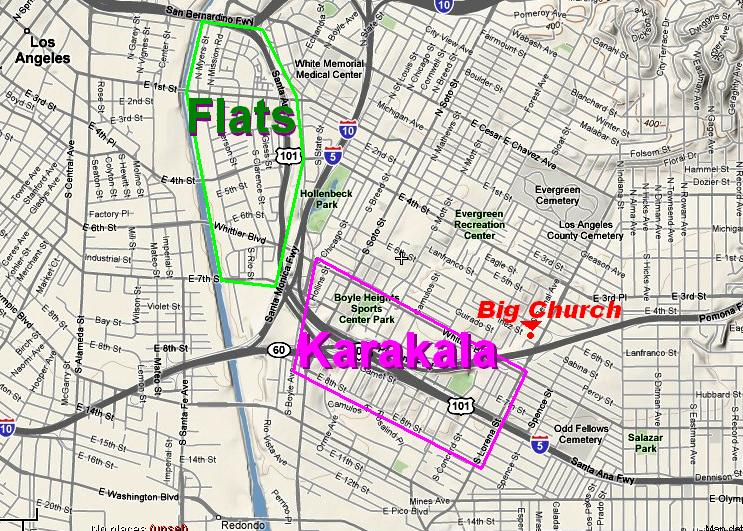 Oral
history reports that the topography of Karakala in Russia
was hilly. In fact, Pryguny who migrated to Los
Angeles and then moved into Boyle Heights, up the hill
from the "Flats", named a part of their neighborhood
"Kara-kala", sometimes pronounced "Krik-kala". It is
bordered on the north by Whittier Boulevard (then
Stevenson Blvd), on the south by Eighth Street, on the
east by Lorena Street and on the west by Boyle Avenue.
Before the Santa Ana (I-5) Freeway was built, the Russian
immigrants said this neighborhood resembled the hills near
Karakala in the old country, especially the long south
slope now under the freeway. For some oral history, see Dukh-i-zhizniki
in America, Chapter 1. Oral
history reports that the topography of Karakala in Russia
was hilly. In fact, Pryguny who migrated to Los
Angeles and then moved into Boyle Heights, up the hill
from the "Flats", named a part of their neighborhood
"Kara-kala", sometimes pronounced "Krik-kala". It is
bordered on the north by Whittier Boulevard (then
Stevenson Blvd), on the south by Eighth Street, on the
east by Lorena Street and on the west by Boyle Avenue.
Before the Santa Ana (I-5) Freeway was built, the Russian
immigrants said this neighborhood resembled the hills near
Karakala in the old country, especially the long south
slope now under the freeway. For some oral history, see Dukh-i-zhizniki
in America, Chapter 1.
 The first most
famous Armenian-Prygun family from Karakala is the
Shakarians, notably son Demos.
They had a large dairy farm in Downey, California,
southeast of Los Angeles. The family history and
testimonial is documented in Demos' book: The Happiest People on
Earth. In it he acknoledges explains their
connection to the Jumper and founded the religious
organization FGBMFI
— Full Gospel
Business Men's Fellowship International. Demos split
from the original Armenian-Pryguny which moved
from East LA to La
Habra Heights, not far from the current UMCA. Our History
describes how his family was saved by Efim G.
Klubnikin's prophesies and by various zealous Spiritual
Christians who regularly visited Karakala village, the
migration, and meeting Protestants
in Los Angeles. Also, the fate of their Karakala
village is reported: "Two years later, the
great World War I broke out, and in the terrible
onslaught, when Turkey overran Armenia, every soul in Kara
Kala was wiped out." The first most
famous Armenian-Prygun family from Karakala is the
Shakarians, notably son Demos.
They had a large dairy farm in Downey, California,
southeast of Los Angeles. The family history and
testimonial is documented in Demos' book: The Happiest People on
Earth. In it he acknoledges explains their
connection to the Jumper and founded the religious
organization FGBMFI
— Full Gospel
Business Men's Fellowship International. Demos split
from the original Armenian-Pryguny which moved
from East LA to La
Habra Heights, not far from the current UMCA. Our History
describes how his family was saved by Efim G.
Klubnikin's prophesies and by various zealous Spiritual
Christians who regularly visited Karakala village, the
migration, and meeting Protestants
in Los Angeles. Also, the fate of their Karakala
village is reported: "Two years later, the
great World War I broke out, and in the terrible
onslaught, when Turkey overran Armenia, every soul in Kara
Kala was wiped out."
The current fame is dominated by celebrity Kim
Kasrdashian who has relatives, born in Karalaka,
buried in the old
Prygun cemetery in East Los Angeles.
The original Armenian-Prygun congregation
eventually moved from East LA to La Habra Heights, not far
from the current UMCA. The history of the Armenian Pryguny
describes how, along with the Shakarian family, many other
Armenians in Karakala were saved by Efim G. Klubnikin's
prophecies and by Spiritual Christians who regularly
visited Karakala. Also, the fate of their Karakala village
is reported: "Two years later, the great World War I broke
out, and in the terrible onslaught by Turkey between 1918
- 1920, those who did not heed the Klubnikin's prophecy
were either murdered or fled for their lives to Russia.
Excerpts
about the Armenian-Pryguny and Karakala, from Molokans
in America by John K Berokoff
Chapter 1
A large
neighboring Armenian
village, Karakalla, became converted to the
Christian Jumpers, most of whom eventually came to
America at the same time as the Russian Molokans.
Meanwhile
Klubnikin took it upon himself to inform the villagers
in the Erevan region. Traveling from one village to
another, he confided his revelations to elders in that
area who, in his opinion, were sympathetic to the cause
but being told about others who were not favorably
disposed and fearing betrayal as an agitator, he
returned to Romanovka and concentrated his efforts in
the region of Kars, not neglecting to inform the Armenian brethren
in Karakalla that unless they left the country
their people will endure far more in the coming period
of tribulation than their Russian brethren. This warning
was heeded by the majority of the Dukhonvy Armenians
and when the time came they followed the latter to
America. [Footnote: The prophesy[sic] concerning the
Armenians literally came to pass in the first world war.
When the Turkish army marched through the area in 1917,
they committed unspeakable atrocities against the
Armenian people in all the villages, including Karakalla.
For that reason the memory of Efeem Gerasimitch
Klubnikin is revered among the Armenian Molokans
to this day.]
This debate
continued in all Molokan villages throughout
Trans-Caucasia and the Trans-Caspian regions for about
three years or until the beginning of the winter of
1904.
... Very
early in that winter a conference was assembled by the
elders of the Kars region in the village of
Novo-Mihailovka where representatives of ten communities
were present, including a leading member of the Armenian community
of Karakalla, Ardzuman Ivanitch Ohanessian, who
was much respected in the Russian Molokan communities.
For that reason the memory of Efeem Gerasimitch
Klubnikin is revered among the Armenian Molokans
to this day.]
Chapter 2
Evergreen
Cemetery ... The Armenian Molokans too, were
participants in the undertaking and quite a number of
their people were buried there.
Chapter 3
The elders
decreed that a large tent was to be installed on some
near-by vacant lot and that Paskha should be observed
together by all congregations after a three-day fast to
conform to the command of the Holy Spirit. ...
including the Armenian
brethren.
Chapter 7
[Page 135] At the end of February, 1945 the Advisory
Council compiled and circulated an accounting of total
sums collected from the entire brotherhood and the
amount contributed by each contributing congregation,
including $127.00 by the Armenian Molokan Church,
$127.00
My Trip to Turkey,
1999
Karakala means "Black
Fortress"
By Joyce Keosababian-Bivin, an
American-Armenian-Jumper who has been exploring her
family history for over 15 years. She has visited
Armenia several times. The photos are hers.
According to oral tradition, Karakala was an Armenia
Protestant village — some Prygun Armenians and
some regular Protestants.
My grandfather Zorab and his brother John Keosababian
had a sister named Anna, who was also called Shogho, and
in the old family letters, sometimes referred to as
Abla, meaning "eldest" sister. Anna married a Prygun
named Vasili Artyomovich. Their children were Alex,
Katya, Uliasha, Vasili, Ivan and Mania. After Zorab and
John went to America, they exchanged letters with their
father Yacov (Hagop), Anna, Vasili and Alex, and later,
their daughter Mania continued corresponding with her
uncles in America.
Manya married Nikolai Fydorovitch Polunin. They had nine
children; Vasili, Ona, Katia, Grisha, Yasha, Vania,
Ivan, Dunia and Tania (Tat'iana). They lived in the
Molokan-Jumper village of Malaia-Vorontsovka (now named
İncesu),
near
Karakala,
Dubovka and other villages where Molokans and Jumpers
lived. My great-grandfather Hagop Keosababian lived in
Karakala, Malia-Vorontsovka, Dubovka and Cakmak
[near: Çalkavur].
The return address on some of Manya's letters had the
family name Dagala. During the Russian period, mail was
not delivered to the villages outside of Kars, so I
always assumed Dagala was the name of the merchant or
place where our family received their mail. For over
eight years, I had been trying to find the descendants
of my great Aunt Anna but to no avail. Telephone calls
in America and an Internet search all brought no
results.
One day in desperation, I decided to write to the
Dagala address and ask if those living there remembered
the Polunin family and possibly knew where they went. I
had the letter translated into Turkish and finally last
July, after waiting for a couple of months, mailed it. I
mailed it doubting that it would reach that address and
even more doubtful that I would receive an answer.
Meanwhile, I made a serious decision to go to Turkey
with Armen Aroyan's Historic Armenia Tour where
Armenians, mainly from America, visit places where
their parents and grandparents lived before they came to
America or perished during the massacres. I have for
many years dreamed of visiting Kars and finding
Karakala. Finally my dreams were coming to pass.
After I made the decision to go on this trip, to my
great surprise, I received a reply from the son of
Tatiana, the granddaughter of my great aunt Anna who
married a Jumper. He informed me they were still living
in the same village (Malia-Voronstovka), now called
Incesu, and invited me to visit them, and included their
phone number.
On September 7, I flew to Istanbul and joined the small
group of Armenians from America. Very early the next
morning we flew to Kars, via Ankara. We arrived in Kars at
10:30 a.m. and called Tatsyana to tell her we were on our
way. There it was — Kars, right before my eyes. I stood
and looked at the Kars sign at the airport and could not
believe I was actually here. Right from the airport, we
began our search for Karakala.
A couple of years ago when I called my mother's
90-year-old cousin Myrtle to ask about Karakala, she
said it didn't exist anymore. It had been filled in. I
didn't believe her. I wanted to believe it still existed
and that I would be able to visit it someday. We then
drove straight to Incesu, about 16 miles northeast of
Kars. As we drove into the village of Incesu, there was
a little old lady just standing on the side of the road
of which we paid no attention. Suddenly, Jamal, our
driver stopped the van. He had a "feeling" about this
lady with her long dress, sweater and scarf tied
under her chin and backed up to talk to her. It
was indeed Tat'iana.
We arrived at the house and walked across the street as
a gaggle of geese scurried away. The house was
surrounded by a low brick wall covered with white
plaster and as we followed Tat'iana through the gate, we
saw in the distance two women in long dresses and head
scarves pitching hay down to someone operating a
threshing machine on the other side of the hay stack.
Soon, we met Tat'iana's sons and two daughter-in-laws
who were the women pitching hay to the threshing machine
when we arrived and were now serving us red
Turkish tea in demitasse size glasses. Someone commented
that could have been me pitching hay if my grandparents
had not fled to America.
Tat'ia is 78 years old, and converted to Islam in
order to marry a Turkish man. Now a widow she has five
children. Tat'ia and her three sons still live in the
same village where her parents and grandparents lived. Some of her
brothers and sisters live in Tbilisi (Georgia), Moscow
(Russia), Ankara (Turkey), and the U.S. Her sister
Katia, lives in Stavropol, Russia. In 95 years nothing
much seems to have changed in the village except for
electricity and television. Hay wagons are now pulled by
tractors. It was hard to comprehend that I was standing
in the same village and perhaps the same house as my
great grandparents and their family.
I learned that after Kars was turned over to Turkey by
Russia, many Armenians and Russians Turkified their
surnames. Mania's husband changed their family name from
Polunin to Dagala. Most of the remaining Spiritual
Christians left in 1962-1964. [In 2009 I learned
that up to 1000 descendants remain in Turkey.]
We drove through Incesu, formerly Malia-Vorontsvoka,
and visited a family there whose mother was a Russian
married to a Turk. Nothing much seems to have changed in
the village except there was now electricity and
television. Hay wagons are pulled by tractors. It was
hard to comprehend that I was standing in the same
village where possibly my great grandparents and their
family lived.
After Incesu, we drove to Taslica, a primitive Kurdish
village of scattered houses on jagged landscape totally
exposed to the elements. Jamal, our driver, talked to
the chief and some of the men standing around. It was
obvious this wasn't Karakala. But apparently they knew
where it had been and one of the men pointed towards the
east, from where we had just arrived. For awhile, I lost
hope of finding our village and Armen said it was all a
mystery. However, after a few miles, Jamal suddenly
stopped the van and wanted me to see something. The area
we stopped at was flat, perfect for farming (there was a
potato patch across the road), but in the background,
there were a few hilly slopes, one with a crater-like
formation between the slopes, kind of like a small gorge
maybe. A river ran between the hills and the plain.
Jamal began to show me certain rock formations on the
land that indicated the place was inhabited at one time.
We found a whitewashed stone and one that was part of a
door post. I couldn't see the entire length of the land,
but shortly a tractor appeared on the horizon which
could have been a sloped section of a hill.
After our visit, we began our search for Karakala. A
couple of years ago when I called my mother's
90-year-old cousin Myrtle to ask about Karakala, she
said it didn't exist anymore. It had been filled in. I
didn't believe her. I wanted to believe it still
existed and that I would be able to visit it someday.To
condense this part of our adventure, I will confirm
that, yes indeed, cousin Myrtle was right. Karakala is
filled in but we found evidence on the land and
confirmation by nearby villagers of its former existence
as a military outpost and village.
.
The modern town of Kars is clean and bustling with
activity. There is a modern pedestrian walk with
water fountains, shops and outdoor coffee shops.
There was a sunflower seed vender on the sidewalk with
his wagon, selling whole sunflower heads. Kars is 6000
feet high and air was clean and crisp — no smog, no
pollution. Unfortunately, we had only one hour to walk
around before traveling to Ani.
We checked out of our hotel and as we drove down one of
the streets, we passed the old section which is where I
really should have visited. Next time.
|
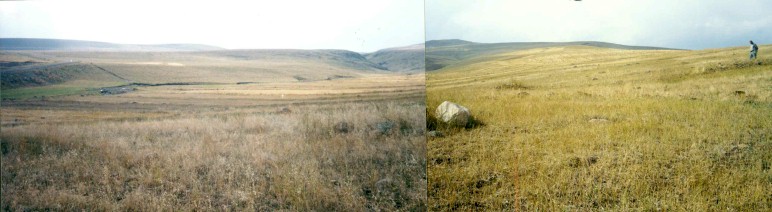 Photo 35. Taken just
south of between Taslica
in 1999. Supposedly Karakala was filled in and buried, but
our driver saw evidence this area was inhabited at one
time. Notice the hills in the background.
Photo 35. Taken just
south of between Taslica
in 1999. Supposedly Karakala was filled in and buried, but
our driver saw evidence this area was inhabited at one
time. Notice the hills in the background.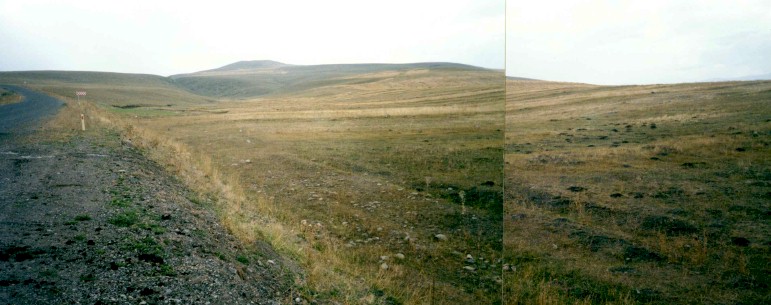

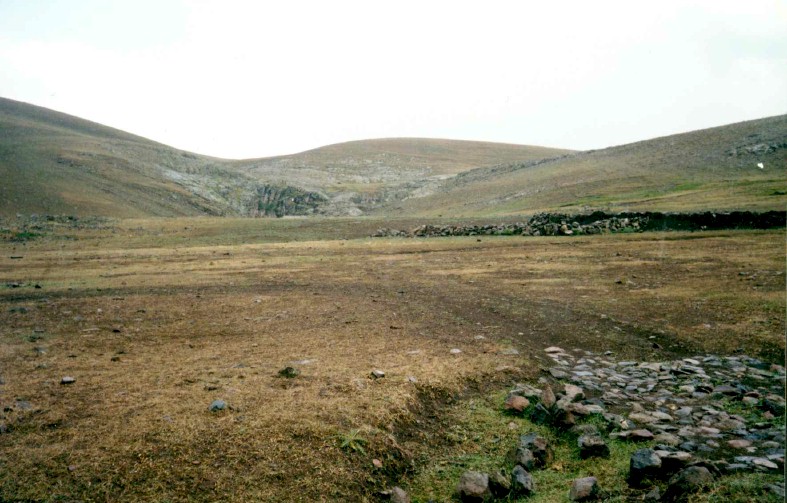 Photo
37. After we left the first site, our driver cut
through a neighboring village and drove out to this second
site which, in his opinion, more likely our Karakala.
Actually, this could be an extension of the first site
only now separated by a road. [These may be the hills that
caused Molokans and Jumpers in Los Angeles to call
their neighborhood, Kara-kala.] [Notice the mountain in
the background are nearly identical to the mountains
behind the village photo taken in the late 1800s.]
Photo
37. After we left the first site, our driver cut
through a neighboring village and drove out to this second
site which, in his opinion, more likely our Karakala.
Actually, this could be an extension of the first site
only now separated by a road. [These may be the hills that
caused Molokans and Jumpers in Los Angeles to call
their neighborhood, Kara-kala.] [Notice the mountain in
the background are nearly identical to the mountains
behind the village photo taken in the late 1800s.]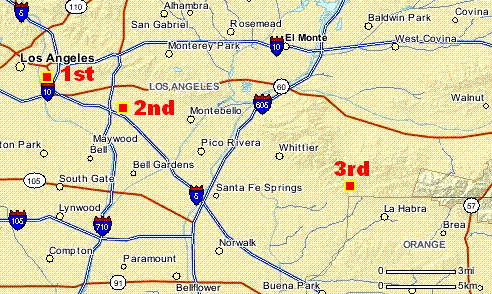 The
Armenian-Prygun congregation in America was
first located in the Los Angeles "Flats" near the
other Spiritual Christian congregations, marked "1st"
on the map right. Like all the immigrants from Russia,
services were held temporarily in homes. We used at
least 3 homes homes in the "Flats".
The
Armenian-Prygun congregation in America was
first located in the Los Angeles "Flats" near the
other Spiritual Christian congregations, marked "1st"
on the map right. Like all the immigrants from Russia,
services were held temporarily in homes. We used at
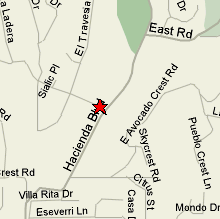
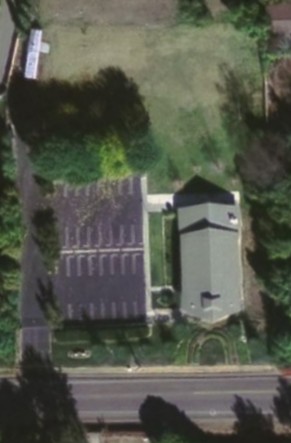
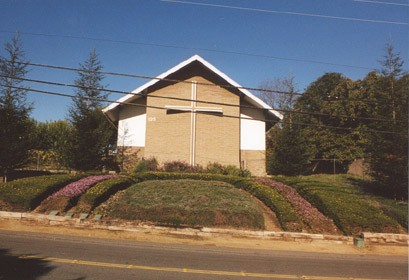
least 3 homes homes in the "Flats".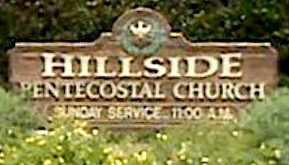 About 1970,
the congregation moved further east closer to their
membership population. They purchased their third
building from the Lutherans in La Habra Heights, on 125
West Road, one door west of Hacienda Blvd, about
a mile north of Whittier Blvd, between the UMCA in
Hacienda Heights and the relocated Dukh-i-zhiznik
assemblies in Whittier, marked "2nd" on the map above;
and maps and photos below.
About 1970,
the congregation moved further east closer to their
membership population. They purchased their third
building from the Lutherans in La Habra Heights, on 125
West Road, one door west of Hacienda Blvd, about
a mile north of Whittier Blvd, between the UMCA in
Hacienda Heights and the relocated Dukh-i-zhiznik
assemblies in Whittier, marked "2nd" on the map above;
and maps and photos below.